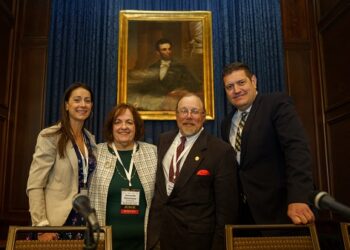

by Phil Neuffer
That’s what Bruce Sim remembers asking his colleagues regularly on Friday nights in the late 1990s when he was working for FINOVA Capital. Even 20 years since the former commercial finance giant filed for bankruptcy and ultimately dissolved, Sim still holds a special place in his heart for that era.
“It wasn’t because we had to be there — we wanted to be there,” Appleton, who now serves as executive vice president of Briar Capital Real Estate Fund, says.
“If you were in finance, it was the shop to work at,” Robyn Barrett, managing member and owner of FSW Funding and a former vice president of business development at FINOVA, says. “They only hired the top of the top, and every person that worked there was definitely an A-type personality.”
“I’m not saying we spawned the alternate finance business in Canada, because it did exist, but alternate finance in Canada got credibility through FINOVA,” Sim says. “Businesses that never would have dreamed of talking to anybody other than their bank started to consider the world of alternate finance in Canada. I think that’s a lasting legacy that [FINOVA has] as a company.”
While FINOVA seemed impressive from the outside, the people who worked there got a better look at what set it apart. As Donna Calderaro, a former vice president at the company and a current senior vice president and business development officer at People’s United Bank, puts it, FINOVA put in the time to teach its employees every aspect of asset-based lending while providing mentors and tools to help everyone succeed.
FINOVA was also rabidly focused on the sales side, with Appleton calling the sales department “the head of the dog instead of the tail,” making for a culture that “was different than anything that I’ve ever experienced before or after.” As a company with a litany of distinct lending groups, cross-selling was a major part of FINOVA’s approach.
FINOVA was also a pioneer in other ways. For example, Sim notes the company developed a strong portfolio of warrant interests in middle-market companies through its corporate finance division, which provided conforming ABL and stretch pieces in return for warrants in a way bank financing just couldn’t match.
FINOVA also stood out for how it evaluated deals, as it emphasized the four C’s of credit: cash flow, capital structure, collateral and character, although there were some specialty lending groups at the company that took a collateral-first approach.
All of FINOVA’s philosophies were built on its aggressive growth goals. According to Barrett, the most recent stock price for the company was on display in multiple places in the company’s offices every day. Barrett says that singular focus and the benefits it provided were a product of the work of Samuel L. Eichenfield, who served as CEO of the firm.
Nuclear Downfall
“If Sam Eichenfield would’ve remained in place, I think it wouldn’t have caused as much of a liquidity problem for FINOVA,” Barrett says. “But announcing there was going to be issues in the portfolio and Sam Eichenfield stepping down was just a nuclear bomb.”
The writing was on the wall before anything became public. For example, FINOVA leadership scheduled when to write off losses on underperforming loans, with some scheduled for up to 18 months down the line. After the Enron bankruptcy, financial reporting requirements eventually changed.
“It put a lot of pressure on line of business leaders and employees to meet the aggressive goals which were tied to bonuses. I think lending then became a little more aggressive than it should’ve been,” Barrett says, although she contends if Eichenfield had been able to stay on to help clean up portfolio issues and reclaim the confidence of Wall Street and the finance community, FINOVA may have had a better shot at surviving.
As the dominoes continued to fall, so too did some of the company’s top talent. Appleton resigned two weeks before Eichenfield left the company. Barrett departed in March 2000. Sim left in January of 2001, nearly a year after becoming Southeast division manager for the company. Calderaro left in February of 2001 on maternity leave as the company geared up for bankruptcy. More and more followed from there, with the company eventually dying out entirely, with Wurst saying it was finally entirely liquidated in 2009.
Lessons and Legacy
A little more than a year after leaving FINOVA, Barrett founded FSW Funding, a major player in the factoring space still going strong today.
While Barrett launched her own business, Sim and Appleton both continued to make waves while working across multiple roles.
Meanwhile, Appleton went from FINOVA to take on leadership roles at Bridge Finance Group, Wells Fargo, TD Bank and JPMorgan Chase before becoming senior vice president of Briar Capital in 2017 and then adding the role of executive vice president of Briar Capital Real Estate Fund in 2019.
“I took my product [at Briar Capital] national, which is completely different than any asset-based lending shop, but I went to every asset-based lending shop and 90% of them have a FINOVA person there or a connection to a FINOVA person,” Appleton says. “That’s helped me build what I’m doing now very significantly.”
“You go to Secured Finance Network events or Turnaround Management Association events and there’s always someone there from FINOVA, and it’s like a family,” Calderaro says.
“I don’t think it’s an accident that people [from FINOVA] land[ed] on their feet,” Sim says. “People in our industry always tend to take away the best things they’ve learned someplace and bring that to bear in their next role. FINOVA has many ‘best practices’ at work to this day wherever its alumni can be found.”