

The Federal Reserve expanded access to its Paycheck Protection Program Liquidity Facility (PPPLF) to additional lenders and expanded the collateral that can be pledged. The changes will facilitate lending to small businesses via the Small Business Administration’s (SBA) Paycheck Protection Program (PPP).
The Federal Reserve Board also broadened the scope and eligibility for the Main Street Lending Program. As part of its broad effort to support the economy, the Federal Reserve developed the Main Street Lending Program to help credit flow to small and medium-sized businesses that were in sound financial condition before the pandemic.
Paycheck Protection Program
As a result of the changes, all PPP lenders approved by the SBA, including non-depository institution lenders, are now eligible to participate in the PPPLF. SBA-qualified PPP lenders include banks, credit unions, community development financial institutions, members of the Farm Credit System, small business lending companies licensed by the SBA, and some financial technology firms. When the PPPLF was announced, the Federal Reserve said the facility would immediately lend to depository institutions and that non-depository institutions would be added as soon as possible.
Additionally, eligible borrowers will be able to pledge whole PPP loans that they have purchased as collateral to the PPPLF. An institution that pledges a purchased PPP loan will need to provide the Reserve Bank with documentation from the SBA demonstrating that the pledging institution is the beneficiary of the SBA guarantee for the loan.
The SBA’s PPP guarantees loans from qualified lenders to small businesses so that those businesses can keep workers employed. The PPPLF supports the PPP by extending credit to financial institutions that make or purchase PPP loans, using the loans as collateral. The additional liquidity from the PPPLF increases the capacity of financial institutions to make additional PPP loans.
Further details on the PPPLF are available here.
Main Street Lending Program
When the initial terms of the Main Street Lending Program were announced, the board indicated that, because the financial needs of businesses vary widely, it was seeking feedback from the public on potential refinements. More than 2,200 letters from individuals, businesses and nonprofits were received. In response to the public input, the board decided to expand the loan options available to businesses and increased the maximum size of businesses that are eligible for support under the program. The changes include:
- Creating a third loan option, with increased risk sharing by lenders for borrowers with greater leverage
- Lowering the minimum loan size for certain loans to $500,000
- Expanding the pool of businesses eligible to borrow
_x000D_
_x000D_
_x000D_
Under the new loan option, lenders would retain a 15% share on loans that when added to existing debt do not exceed six times a borrower’s income, adjusted for interest payments, taxes, and depreciation and other appropriate adjustments. This compares to the existing loan options where lenders retain a 5% share on loans but have different features. Under all the loan options, lenders will be able to apply their industry-specific expertise and underwriting standards to best measure a borrower’s income. In total, three loan options — termed new, priority and expanded — will be available for businesses. The chart below summarizes the different loan options.
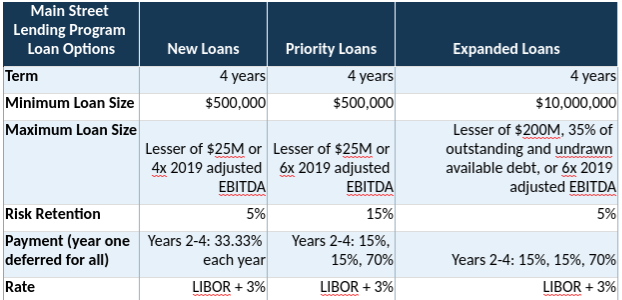
Additionally, businesses with up to 15,000 employees or up to $5 billion in annual revenue are now eligible, compared to the initial program terms, which were for companies with up to 10,000 employees and $2.5 billion in revenue. The minimum loan size for two of the options also was lowered to $500,000 from $1 million.
The board is evaluating a separate approach to meet the needs of nonprofit organizations.
The Main Street Lending Program was established under Section 13(3) of the Federal Reserve Act, with approval of the Treasury Secretary. The Treasury will provide $75 billion for the program using funds from the Coronavirus Aid, Relief, and Economic Security Act. A start date for the program will be announced soon.