


Periods of elevated uncertainty have historically prompted institutional investors to reassess how portfolios generate return, manage volatility, and diversify away from traditional market risk. Today’s environment shaped by higher-for-longer interest rates, selective credit conditions, geopolitical tension, and uneven economic growth we believe has reinforced the need for return streams driven by idiosyncratic, less macro-sensitive factors. Within this context, litigation finance has begun to attract broader attention as a specialty private credit segment supported by structural demand for capital within the legal system and repayment dynamics that are often tied more closely to legal processes than to public market cycles.
Why Now
The case for litigation finance has strengthened as investors seek differentiated sources of return that are less dependent on economic growth, corporate earnings, or broader credit cycles. At the same time, law firms continue to face rising case costs, longer litigation timelines, and limited access to traditional financing solutions. This convergence of investor demand and structural funding needs helps explain why institutional allocators are increasingly evaluating litigation finance through a specialty private credit lens.
Litigation Finance Through an Institutional Lens
At its core, litigation finance involves the provision of third-party capital to law firms or plaintiffs pursuing legal claims in exchange for a share of proceeds or repayment tied to case outcomes. Increasingly, however, the strategy is being approached through a private credit lens. Aperture’s approach to the market is centered on structuring loans directly to law firms, rather than financing individual lawsuits, with loans secured by expected fee receivables from diversified pools of legal claims. These claims are often procedurally mature, near settlement, or already settled, which can reduce investment risk and improve visibility into repayment timelines.
Because repayment is driven primarily by legal process, collateral quality, and case progression, litigation finance can offer exposure to return drivers that differ meaningfully from those of traditional equities and credit. This distinction can be especially relevant in periods when market volatility, credit tightening, or shifting rate expectations challenge more conventional sources of portfolio income.
This differentiated return profile has become more relevant as allocators look for strategies that can complement existing private credit allocations without simply adding additional exposure to corporate, consumer, or real estate risk.
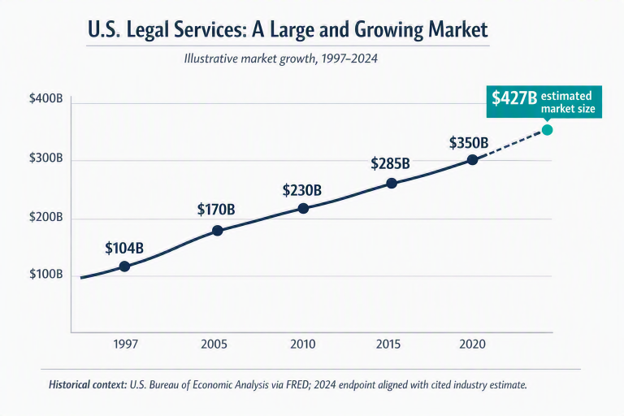
Beyond diversification benefits, the growth of litigation finance is supported by a large and expanding market opportunity. The U.S. legal services industry alone is estimated to be approximately $427 billion[1], providing a substantial foundation for legal funding demand. At the same time, many law firms face structural barriers to accessing traditional financing. Regulations restricting non-lawyer ownership of law firms limit equity capital options, while conventional bank lending often fails to accommodate the irregular cash flows associated with litigation. This combination of structural constraints and growing demand has created a market widely viewed as underbanked and inefficient, opening the door for specialized private capital providers, like Aperture Investors, who can underwrite law firm receivables in bespoke ways that broadly syndicated loans do not, and banks either cannot, or choose not to.
The evolution of the asset class over the past decade has also made litigation finance more accessible to institutional investors. Early approaches often involved single-case investments, which came with binary outcomes and limited diversification. Today, some strategies—including the Aperture Litigation Finance strategy—focus on taking a private credit-like approach to litigation financing, constructing portfolios across multiple cases, law firms, and litigation types, reducing concentration risk and enhancing capital efficiency.
Within this niche, structured lending models have become particularly prominent. These investments typically involve loans secured by diversified pools of legal fee receivables that are supported by robust credit protections like first-priority liens on collateral, conservative loan-to-value ratios, tight cash controls, or covenant packages designed to protect lender capital.
By employing these traditional private credit controls to litigation finance strategies, investors can seek to mitigate two of the most commonly cited risks in the space: binary case outcomes and extended duration.
The Construction of the Strategy
Portfolio construction is also evolving alongside strategic controls. A representative framework may include combining exposure to post-settlement lending — where legal disputes have already been resolved but payments are still pending or completed on defined schedules — with financing tied to near-settlement or short-duration cases. Post-settlement exposures often provide shorter investment durations, while near-settlement opportunities can offer higher yields and slightly longer timelines. Together, these exposures are intended to balance risk, income generation, and capital turnover.
Looking Ahead
Despite growing institutional participation, litigation finance remains a relationship-driven business. Deal sourcing often depends on direct relationships with law firms, claim administrators, and other legal service providers rather than brokered markets. Established networks play a critical role in generating proprietary deal flow and supporting due diligence efforts. Industry data indicates that strong sourcing relationships often built over years of engagement with legal professionals have supported billions of dollars in capital deployment in the sector.[2]
As the market continues to evolve, investor interest in litigation finance is expected to grow alongside it. The strategy sits at the intersection of private credit, legal services, and specialty finance, offering institutional portfolios exposure to a distinct set of uncorrelated economic drivers. While the asset class will always require specialized expertise and careful underwriting, innovations in structuring, diversification, and sourcing infrastructure are helping to make it more accessible to sophisticated allocators.
For institutional investors navigating an uncertain macroeconomic environment, litigation finance is no longer merely an alternative curiosity. It is increasingly viewed as a potential diversifier within their current portfolios one supported by structural demand, expanding market infrastructure, and an evolving set of investment approaches.
[1] The approximately $427 billion figure reflects Mordor Intelligence’s forecast for the U.S. legal services market to reach $427.9 billion by 2029, up from an estimated $375.7 billion in 2024, representing a 2.64% compound annual growth rate. Values are market-size estimates and may differ from U.S. Bureau of Economic Analysis measures of legal services GDP.
[2] Westfleet Advisors, The Westfleet Insider: 2023 Litigation Finance Market Report (2024), https://www.westfleetadvisors.com/wp-content/uploads/2024/03/WestfleetInsider2023-Litigation-Finance-Market-Report.pdf.
Author:
Luke Darkow is a Portfolio Manager at Aperture Investors. With 13 years of investing experience, Luke has focused on sourcing, analyzing, structuring and managing litigation finance private credit investments. Over his career Luke has invested over $1.25 billion of capital in the litigation finance asset class utilizing his extensive sourcing and origination network of plaintiff law firms and legal service providers.
Prior to joining Aperture Luke was a Principal and Portfolio Manager at Victory Park Capital managing a litigation finance asset-based lending strategy. Prior to Victory Park Luke held roles at TPG Capital and Morgan Stanley. Luke received his B.S. in Business Administration, Finance – Applied Investment Management from Marquette University.
Aperture website: apertureinvestors.com