


From zombie companies and MCA stacking to Chapter 15 forum shopping and AI in the courtroom, the 17th Annual Kevin J. Carey Summit offered a frank, wide-ranging assessment of where the credit and restructuring markets stand — and what practitioners at every level need to do differently.
The 17th Annual Honorable Kevin J. Carey Philadelphia Credit & Restructuring Summit was held at the historic Union League of Philadelphia on Thursday, April 30, 2026. The event was co-hosted by the New York Institute of Credit (NYIC), ABF Journal, the Philadelphia Chapter of the Secured Finance Network (SFNet) and the Philadelphia/Wilmington Charter of the Turnaround Management Association (TMA).
The event, which has attracted a crowd of professionals from across the country, has been carefully shaped in recent years to preserve and honor the enduring legacy of the Honorable Kevin J. Carey, a late federal bankruptcy court judge and cherished educator who was actively involved in it for many years.
Opening Remarks and Tributes
Harvey Gross, executive director of the NYIC, opened the event by reflecting on the conference’s roots and evolution over the years. Attendees paused for a solemn moment of reflection as the Honorable Thomas M. Horan remembered the Honorable John T. Dorsey, describing him as a jurist of remarkable capability who handled cases such as the FTX and Mallinckrodt restructurings with grace and a steady judicial demeanor.
Best Presentation Practices for in Court and Virtual Settings
 A luncheon panel, “Making Your Mark: Best Presentation Practices for in Court and Virtual Settings,” moderated by Max Schlan, partner at Thompson Coburn LLP, and featuring the Honorable Thomas H. Horan and Lindsay Rowland, a shareholder at Starfield & Smith P.C., explored how courtroom presentation has evolved in the post-pandemic era of virtual hearings.
The panelists agreed that professional standards remain unchanged regardless of format, with Judge Horan noting simply, “You’re in court whether you’re there by Zoom or in person.” Roland, who acknowledged she rarely visits a courthouse anymore, emphasized the importance of thoughtful backgrounds, proper lighting and reliable equipment, while the judge stressed that audio quality remains his primary concern — “anything that gets in the way of communicating most effectively to the court is only going to make it harder for you to do the job.”
The panel’s most pointed theme was the value of physically showing up for consequential matters: the judge shared a vivid example in which attorneys who came to court were able to negotiate deals in the hallway before a ruling, while the attorney who appeared by Zoom simply had his objection overruled. Roland echoed that sentiment, noting that younger attorneys who began practicing after 2020 “don’t understand how beneficial hallway negotiations really were.”
The session closed with a brief discussion of AI, with Roland saying she limits her use to tightening prose after completing her own research, and the judge acknowledging he can often recognize AI-generated arguments, describing them as “entirely too generic or too surface level to be of any use.”
How Lenders Are Viewing Transactions
 A lenders panel moderated by Terry Keating, Vally National Business Capital – business head at Valley Bank, brought together four seasoned practitioners to discuss current conditions in the credit markets: Rafi Azadian, founder and CEO of Change Capital; Michael Bonner, chair of commercial lending at Stradley Ronon Stevens & Young, LLP; Brian Gleason, senior managing director at J.S. Held and global president of the Turnaround Management Association; and Paul Schuldiner, chief lending officer of Rosenthal Capital Group.
Market Conditions and Deal Flow
Panelists agreed that while liquidity remains abundant, deal quality has deteriorated significantly. More lenders are chasing fewer attractive credits, and companies are routinely receiving five or six competing proposals — yet deals that initially look promising are increasingly failing or being restructured during underwriting. The panelists attributed this to the difficulty businesses face in producing reliable forecasts amid rapid shifts in tariff policy, global supply chains and geopolitical dynamics. Lenders, in turn, are diving deeper into what Paul Schuldiner called “the essence of the business” — assessing whether a company truly has a competitive reason to exist.
Private Credit Under the Microscope
The panel tackled the recent wave of headlines around stress in private credit. The consensus was that the problems are idiosyncratic rather than systemic — certain funds have struggled, but the broader private credit market continues to raise capital and generally perform. Panelists drew a useful distinction between asset-backed and asset-based lenders, noting that some private credit entrants approach credits more like private equity or hedge funds, with less emphasis on granular collateral monitoring. The better private credit firms are learning from traditional commercial lenders, but the incentive structures — focused on deal origination and fundraising rather than loan repayment — can create blind spots.
The Backlog of Credit Stress
Gleason offered a historically grounded observation: for over a decade — accelerated by COVID-era government intervention and a prolonged period of near-zero interest rates — the normal baseline of business defaults and distress has been suppressed. That backlog is now slowly surfacing. Companies that have spent years merely servicing interest, deferring investment and adjusting EBITDA to stay viable are beginning to show up in workout pipelines. Gleason compared them to “zombie companies,” noting that businesses that haven’t reinvested are harder and more costly to turn around when the time finally comes.
Tariff Refunds and Collateral Uncertainty
A focused discussion emerged regarding tariff refunds as potential collateral. Schuldiner indicated that Rosenthal is not currently including tariff refunds in its borrowing base, citing too much policy uncertainty — the rules have already shifted dramatically and the possibility of government offsets or further changes makes the asset difficult to underwrite reliably. The group broadly agreed that clarity is nowhere in sight.
Legal Protections and the MCA Warning
Bonner urged lenders to resist pressure to soften loan documentation — even seemingly minor concessions (such as requiring advance notice before exercising remedies under a stock pledge) can hamper a lender’s ability to act decisively in a downturn. He highlighted reserves, collateral reporting frequency, EBITDA definitions, cash dominion and MAC clauses as key provisions deserving close attention.
On merchant cash advances, the panel sounded a unified alarm: MCA exposure is proliferating, often hidden from senior lenders, and by the time it’s discovered, the borrower is frequently in an unrecoverable position. Panelists urged lenders to proactively communicate with borrowers about alternative liquidity sources — and to vet any junior capital partners carefully before allowing them into a deal structure.
Turnaround Panel: Distress and Restructuring in the Skilled Nursing Facility Industry
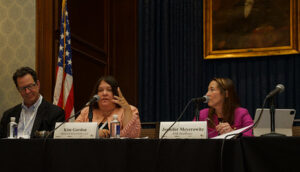 A focused panel on the skilled nursing and senior housing sector featured three practitioners: Rob Katz, managing director at EisnerAmper, who moderated; Kim Gordan, senior managing director at Monticello Asset Management, a middle-market non-bank lender specializing in senior housing and multifamily with over $8 billion under management; and Jennifer Meyerowitz, chief growth officer and general counsel at SAK Healthcare, a turnaround and operational management firm that deploys on-site clinical and administrative teams to stabilize distressed senior living facilities, and who also serves as a court-appointed receiver.
A Sector Under Structural Strain
The panel opened with a striking demographic context: roughly 70% of adults aged 65 and older will require some form of senior housing, and the population aged 80 and older is projected to grow by 48% by 2030 — creating demand for an estimated 564,000 additional units. Yet the economics of meeting that demand are deeply strained. Occupancy has slowly recovered from COVID-era lows, but many fully occupied facilities are still cash-flow negative. Labor costs are the primary culprit: nursing wages are roughly four times pre-COVID levels, and facilities frequently rely on expensive agency nurses to meet regulatory staffing minimums. Reimbursement rates from Medicare and Medicaid have not kept pace, creating a structural gap between what care costs and what operators get paid. Rising patient acuity — as residents now tend to arrive sicker and later in their illness progression — adds further clinical and financial pressure.
The Billing and Collections Minefield
A recurring theme was the extraordinary complexity of Medicare and Medicaid billing, which varies from state to state and is highly sensitive to documentation accuracy. A single miscoded entry can trigger months-long reimbursement delays; clerical errors — like a date typo — can result in six-figure recoupment demands from CMS that require outside counsel to fight. Meyerowitz described situations in which a state Medicaid office’s security breach halted payments to a facility for six months. Gordan emphasized that when underwriting a transaction, Monticello scrutinizes billing systems and collection processes as carefully as it does collateral — facilities that cannot demonstrate rigorous, timely claims submission are viewed as high risk regardless of their occupancy rates. Both panelists stressed that specialized healthcare billing expertise is essential and genuinely scarce.
Operational Turnaround: What Actually Works
SAK’s turnaround methodology goes well beyond financial restructuring. Meyerowitz described deploying full on-site teams — nurses, dietary specialists, maintenance staff, marketers — to stabilize buildings from the ground up. Key priorities include reducing reliance on expensive agency nurses by recruiting permanent staff, renegotiating vendor contracts, streamlining kitchen operations and installing a strong marketing director to rebuild census through physician referrals and community relationships. Census — the number of occupied beds — is so central to cash flow that Monticello monitors it weekly and, in some cases, daily across its portfolio. Leadership assessment is equally critical: absentee operators, inexperienced management teams, and facilities with deteriorating regulatory survey results are all treated as serious warning signs.
Lender Protections and the Receivership Option
For lenders facing a troubled credit, simply foreclosing and shutting down a skilled nursing facility is rarely viable. An empty building has minimal liquidation value — as Gordon put it, roughly what a piece of paper is worth — and a proper wind-down requires 60 to 90 days of continued operations, staffing and regulatory compliance, with a state-approved shutdown plan. Receivership was presented as the preferred solution when an operator must be replaced: a receiver steps into the shoes of the existing licensee, allowing operations to continue without triggering a relicensing process that can itself take 60 to 90 days. Meyerowitz described structuring receivership orders to include sale authority and protections analogous to an automatic stay, enabling the receiver to stabilize, operate and ultimately market the facility — with lender funding bridging the gap. The panel’s closing message was practical: skilled nursing is a viable and active lending market, but it demands genuine sector expertise, strong operator selection and partners who understand that exiting a problem credit in this industry is measured in months, not days.
Views from the Bench
 A panel of bankruptcy court judges and practitioners tackled several pressing issues at the intersection of law, finance and technology in the final panel of the day: Views from the Bench. The session was moderated by Mark Indelicato, partner and managing partner of the New York Office of Thompson Coburn LLP and featured the Honorable Ashley M. Chan, Chief Judge of the U.S. Bankruptcy Court of the Eastern District of Pennsylvania; the Honorable Thomas M. Horan of the U.S. Bankruptcy Court of the District of Delaware; the Honorable Karen B. Owens, Chief Judge of the U.S. Bankruptcy Court of the District of Delaware and practitioners Sean M. Beach, co-chair of the Bankruptcy and Restructuring Group and partner at Young Conaway Stargatt & Taylor, LLP and Mark Minuti, parter at Saul Ewing LLP.
What the Judges Would Change in the Bankruptcy Code
The panel opened with each judge sharing what they would amend if given the chance. Chan focused on student loans, arguing that the current standard for dischargeability — requiring debtors to prove debilitation for the life of the loan — is punitive and falls hardest on first-generation college students who lacked financial guidance when taking on debt. The problem extends to parents: she described a 75-year-old man in her courtroom who co-signed loans and had no path to relief despite serious health issues. Horan raised a broader philosophical concern: the Bankruptcy Code is structured with deep trust for corporate entities and deep mistrust of individuals, and he argued that this needs to be reconsidered. He also flagged the Section 546(e) safe harbor defense as too broadly worded and counterproductive to the Code’s purposes.
Subchapter 5: Underutilized but Worth Saving
The panel agreed that Subchapter 5 of Chapter 11 — created to provide a streamlined, lower-cost reorganization path for small businesses — has largely worked as intended but is currently hamstrung by a debt limit that has reverted to a too-low threshold after a pandemic-era expansion. Practitioners noted that while early cases involved friction around the role of the Subchapter 5 trustee, that has largely smoothed out. The consensus was that the limit should be raised — one panelist suggested $15 million — and that U.S. Trustees should take a more deferential approach rather than objecting to everything and driving up costs.
Creative Lawyering: Chapter 15 and Forum Shopping
A substantial portion of the discussion focused on how restructuring professionals are using Chapter 15 — the U.S. recognition framework for foreign insolvency proceedings — to achieve results no longer available domestically after the Supreme Court’s Purdue Pharma decision barred non-consensual third-party releases in Chapter 11 cases. Practitioners are now examining restructuring in the UK, Canada, Mexico and Brazil, then seeking Chapter 15 recognition in the U.S. for plans that include such releases.
The panel discussed Judge Horan’s decision in Credito Real as a significant opinion holding that recognition of a Mexican restructuring plan containing non-consensual third-party releases was not manifestly against U.S. public policy. The judges offered a notable perspective shift: while practitioners tend to view Chapter 15 as a workaround, the judiciary approaches it through the lens of global judicial comity — if a foreign court ran a fair adversarial process, U.S. courts should generally enforce those orders, just as U.S. courts would expect foreign courts to enforce theirs.
Administratively Insolvent Cases and the Post-Jevic Puzzle
The panel tackled the increasingly common problem of Chapter 11 cases that are so deeply overleveraged they are likely to become administratively insolvent — unable to pay even administrative priority claims, let alone unsecured creditors. Since the Supreme Court’s Jevic decision prohibited structured dismissals that skip priority classes, practitioners have been engineering alternative structures: third-party funds (contributed by secured lenders or buyers outside the estate) are placed into ombudsman-administered trusts for the benefit of unsecured creditors, on the theory that non-estate money isn’t bound by the Code’s priority scheme.
The judges acknowledged the creativity but were candid that these structures may face Supreme Court scrutiny — and that what looks equitable at the bankruptcy court level can look quite different on appeal. The Coach USA case was cited as a carefully constructed example in which all administrative claims were paid, and the unsecured creditor pool was built consensually, with opt-in provisions. Practitioners were urged to read plans and procedures carefully, as opt-in and opt-out structures around discounted administrative claim payments are proliferating.
MCAs: From Nuisance to Litigation Battleground
Building on earlier panels, the judges confirmed that merchant cash advance situations are increasingly shaping how they assess a case from the moment it lands on their docket. One judge said seeing MCAs on the creditor list is a leading indicator that the case will likely convert to Chapter 7 — the businesses that resort to stacked MCA financing are typically already past the point where a Chapter 11 reorganization can save them. The core legal battleground remains the same: are these transactions true sales of receivables or disguised loans?
Courts focus on risk — if the MCA party bears virtually no risk of non-payment, the transaction looks like a loan regardless of how the documents are drafted. One judge described a case where, after MCA parties failed to engage promptly, a DIP order was entered, liens were placed and when the parties finally appeared at confirmation expecting an on-the-spot ruling, the judge instead scheduled a full evidentiary trial — prompting an immediate settlement. Practitioners noted that MCA documents are frequently inconsistent even within a single borrower’s stack of agreements, and that term sheets often explicitly call the arrangements loans while subsequent agreements purport to be sales. Legislative efforts in some states to restrict MCA practices are emerging, but panelists were skeptical that federal change is imminent.
AI in the Courtroom: Competence, Not Stigma
The panel closed with a discussion of artificial intelligence in legal practice. The judges were measured: if AI is being used correctly — as a drafting aid, research accelerator or administrative tool — they wouldn’t necessarily know, and that is the right outcome. The concern is not AI itself but attorneys failing to verify AI-generated output, as the Sullivan & Cromwell phantom-citation episode illustrated. One judge pushed back on local rules requiring AI disclosure, arguing they risk stigmatizing a technology wholesale when the underlying obligation — attorney competence and verification of what is filed — is already fully covered by Rule 11.
Practitioners raised a newer problem: clients themselves are using AI to review draft legal documents and push back on attorneys with AI-generated commentary, requiring a new kind of expectation management. The panel also flagged attorney-client privilege risks from AI note-taking tools in meetings, a concern one attorney said is not yet settled in case law but is actively evolving.
Conclusion
What emerged across the day’s panels was less a set of warnings than a call to rigor. Whether the subject was MCA exposure creeping into senior lenders’ portfolios, the structural economics of skilled nursing facilities, or the creative use of Chapter 15 in the wake of Purdue Pharma, the underlying counsel was the same: know your collateral, know your borrower, know your documents — and engage your advisors before the problem finds you. It is precisely the kind of practical, experience-driven guidance that Judge Kevin J. Carey championed throughout his career on the bench and in the classroom, and it remains the enduring spirit of the Summit that bears his name.