

On April 30th, 2025, lenders and the advisors who support them, including turnaround professionals, attorneys and others, attended the 16th Annual Philadelphia Credit & Restructuring Summit, hosted by ABF Journal , along with the New York Institute of Credit, the Turnaround Management Association Philadelphia-Wilmington Chapter, and the Secured Finance Network Philadelphia Chapter.
This annual event has been renamed to honor and preserve the legacy of the late Honorable Kevin J. Carey (ret.), who had one of the most memorable careers in bankruptcy. He served as a Bankruptcy Judge in both the Eastern District of Philadelphia and in the District of Delaware, which is quite unique, and he was also the first judge to serve as global chair of the Turnaround Management Association. Judge Carey was well known for his dedication to bankruptcy-related education and mentorship of industry professionals who will continue to benefit from his knowledge and wisdom for years to come. A beloved federal bankruptcy judge, longtime lawyer and adjunct law professor, he was an expert on corporate insolvency and restructuring, tax and labor claims, and international rules, and he helped define, enforce, and reshape bankruptcy law across the country. He will long be remembered by all of us in the restructuring world, and it is quite appropriate that this program has been renamed in his memory and honor.
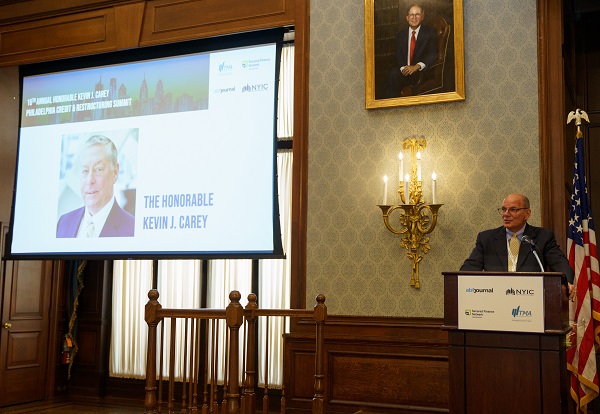
Beginning with a luncheon program and running through a cocktail reception, attendees were treated to a series of interesting and timely programs by panels which included lenders, attorneys and bankruptcy judges.
The first panel, “What Lawyers Should Know When Dealing with The Bench,” was moderated by Chief Bankruptcy Judge Michael B. Kaplan of New Jersey and also featured Bankruptcy Judges Rosemary Gambardella and Jerrold N. Poslusny, both also from New Jersey, and Judge Kaplan’s law clerk, Rebecca Earl. It took place during lunch and focused upon what judges look for from attorneys in bankruptcy cases, including upholding the applicable ethical rules in communications between legal counsel and the bench. This is an important subject, since such communications are often critical to moving a case forward, whereas avoidable delays can adversely affect the outcome and the recovery by stakeholders.
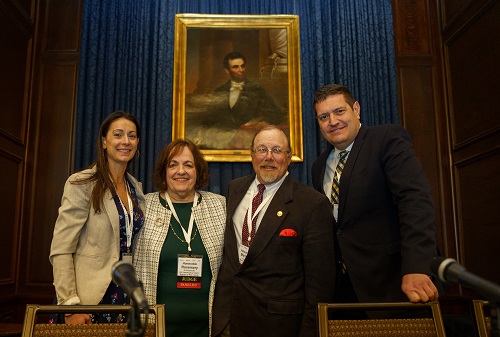
The panel covered some basics such as hearings held via Zoom instead of in-person, and the importance nonetheless of dressing properly, participating from a quiet location without distractions, displaying one’s full name correctly and paying attention to what may be visible in the background. While the speakers agreed that attendance in person can be more effective since it makes it easier to read the expressions of the judge and others, all agreed that, post-pandemic, remote attendance is here to stay.
The judges’ views differed on the issue of meeting with counsel to discuss possible settlement of disputes without the court reporter present. However, all agreed that, at the very least, an accurate record that such a meeting occurred should be made. And there was strong consensus regarding the importance of all parties showing proper respect to opposing parties and their counsel, as well as to court personnel.
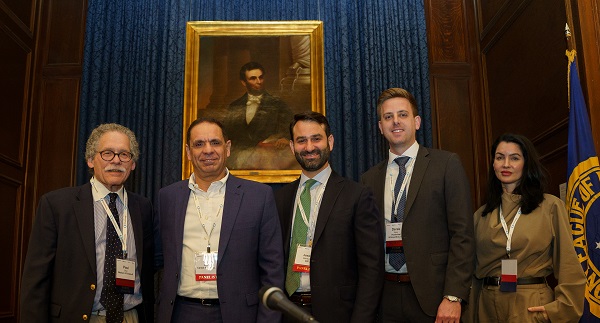
The second panel, characterized as a “Lender’s Panel” and titled “How Different Lenders See a Transaction Differently,” was moderated by Paul H. Shur, a Shareholder at the Becker New York law firm, and head of its Banking and Finance Group, who frequently represents lenders. Panelists included: Vincent Belcastro, a longtime senior lending officer at several leading New York banks, and currently at Camley Advisors, an advisor to lenders and borrowers; Joseph Iannuccilli, a Managing Director at CIFC Asset Management; Derek Sigler, EVP and Portfolio Manager at Rosenthal & Rosenthal, and Essa Thirry, Senior VP and Head of Revenue at Change Capital.
To set the stage for how lenders’ viewpoints might differ, the panel introduced a hypothetical transaction containing multiple issues that can often arise in for lenders. These included:
- The lenders being composed of a primary lender and a 20% participant
- The borrower being an importer that is currently in workout due to there being a substantial overadvance on the loan, as well as insufficient EBITDA under the loan covenants
- Lack of personal guarantees by the owners
- The borrower having important licenses from suppliers to sell name brand clothing, in which licenses the lenders have a security interest, but with the borrower being behind on license royalty payments
- Company-occupied real estate on which mortgage financing may be available to support the loans
- Seasonality, since the borrower’s clothing inventory is seasonal, and therefore less valuable off-season
- A potential equity sponsor that sees unrealized potential in the business and might be interested in participating in a sale that includes restructuring
The panelists discussed the above issues from various viewpoints, including how the overadvance had been permitted to occur, the possibility of utilizing factoring and/or mezzanine financing to increase liquidity, different restructuring methods taking into account the prospective investor/acquiror, and how the different asset classes — accounts receivable, inventory, real estate, licenses, etc. — figure into the restructuring process. The panelists agreed on the importance of having qualified turnaround professionals involved in the process, including for vital cash flow planning.
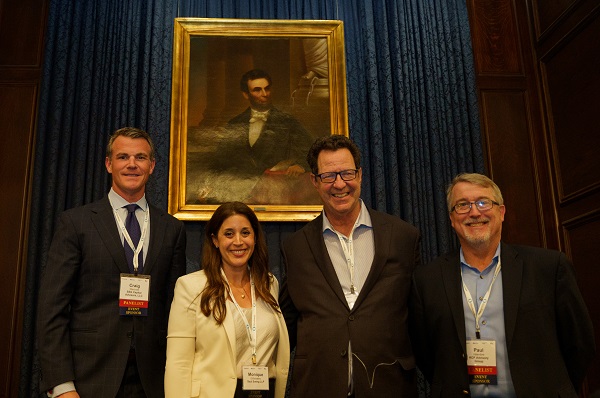
The next panel, characterized as a “Turnaround Panel,” was titled “Private Equity’s Involvement in Owning Hospitals and Senior Care Centers — The Good, The Bad and The Other.” It was moderated by Craig Warznak, a Director at SSG Capital Advisors, and panelists included: Monique B. DiSabatino, a Partner and Vice Chair of the Bankruptcy and Restructuring Practice at the Saul Ewing LLP law firm; Robert Katz, a Managing Director at Eisner Advisory Group LLC; Jennifer Leibowitz, a Senior VP at lender SLR Healthcare ABL and Paul Valentine, a Senior Managing Director at KCP Advisory Group, LLC.
This program accentuated the special challenges that healthcare can present in restructuring, including the concentration in the sources of accounts receivable that often occurs due to there being relatively few payors, e.g., Medicare, Blue Cross, etc., the lack of any meaningful inventory as a source of collateral, and the sensitivity of potential bad publicity regarding actions taken against a healthcare provider in default due to the interests of patients and families that are not part of the lending equation.
An additional dimension was provided by the increasing involvement of private equity investment in the healthcare space, since it is an industry where substantial consolidation is often available. The panel also discussed issues raised by the understandable fixation of private equity firms on the return on their investment, as well as their possible inability to subsequently invest more money once they exhaust each “fund” that they have raised and their sensitivity to any dilution that may be required if new investors are brought in.
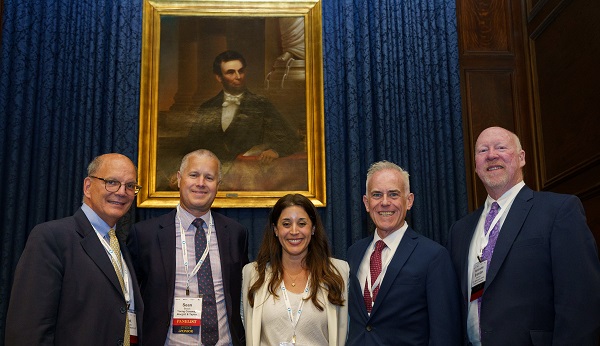
The final panel was “Views from the Bench,” featuring as moderator Mark Indelicato, a Partner at the Thompson Coburn LLP law firm, and panelists including: Bankruptcy Judges Brendan L. Shannon and Thomas M. Horan, both of Delaware; and Sean Beach, a Partner and Co-Chair of the Bankruptcy and Restructuring Group at the Young Conaway Stargatt & Taylor, LLP law firm in Delaware, and Monique B. DiSabatino, a Partner and Vice Chair of the Bankruptcy and Restructuring Practice at the Saul Ewing LLP law firm.
This panel revisited some of Judge Carey’s well-known cases and discussed such recently newsworthy topics as the utilization of repeat bankruptcy board directors, the inclusion of third-party releases and the sensitivity of cases that may involve layoffs and terminations, as well as those involving healthcare as mentioned above. The panel also went into greater detail regarding some of the points that had been expressed by the initial panel on “Lawyers Dealing with The Bench,” including the important ethical rules, but also discussed the bankruptcy process in general when it comes to lender interests and restructuring overall. As is widely recognized, the state and federal courts in Delaware take their role very seriously, given Delaware’s position as a venue of choice when it comes to company incorporation as well as for pursuing litigation and bankruptcy. These principles were on display as we heard both the judge panelists and the attorney panelists expressing views that clearly proceeded from an inquiry into what is best for all parties concerned, taking into account their priority of interests under the bankruptcy code and other applicable laws.
The program hosts mentioned initially above can be proud of an excellent program that was interesting, valuable and well-attended. Participants also got value from the networking time that was provided during breaks between programs, and the cocktail reception that followed the programs. Lenders, turnaround professionals and attorneys should be on the lookout for this program next year and register for it at an early date.
Howard Brod Brownstein is president of The Brownstein Corporation, which provides turnaround and crisis management for borrowers, and also obtains sellers and refinancing, including for healthy companies. He serves as chair of ABF Journal’s Editorial Board.